

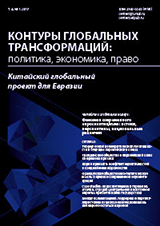
Scientific and practical peer-reviewed journal “Outlines of global transformations: politics, economics, law” (“Kontury globalʹnyh transformacij: politika, ekonomika, pravo”)
The XXI century world turned out to be much more complex and multi-layered than the XX century scholars have assumed. The current situation cannot be described in terms of generalization and universalization. Scholars who once considered such processes the key factor of the development process nowadays either revise their position or fail to describe the new reality. Thus, we have to admit that today`s world is an extremely complicated object for an academic analysis and this analysis cannot be made without new approaches and categories.
We did not achieve a huge progress. However, we also did not face a huge regress, which could be seen as a process of simplification (which has nothing in common with our current situation). Today we face an unprecedented reality, characterized by the eclectic combination of progressive and archaic elements, rational and irrational factors, general and special sides. The academic journal “Outlines of global transformations: politics, economics, law” (“Kontury globalʹnyh transformacij: politika, ekonomika, pravo”) contains studies of current changes in national, regional and global perspectives. The topical diversity and ambitions of our researchers make it extremely difficult to distinguish one topic from another: one cannot consider politics ignoring economics, social institutes, cultural factors, military power. That is why, most of our authors do interdisciplinary research, presenting a great example of comprehensive academic analysis. We are highly aware of another great risk which modern scientists face: global process, being extremely complicated phenomena, can be misunderstood and misinterpreted because of the one-sided national view. In order to avoid this risk, we welcome scholars from any part of the World! We hope that due to this diversity, our readers will get a real opportunity to understand our new reality in its diversification.
The academic journal “Outlines of global transformations: politics, economics, law” was registered on February 4th, 2021 by the Federal Service for Supervision of Communications, Information Technology, and Mass Media as a mass media organization. Certificate of registration: ПИ № ФС 77-80326. The journal was founded in 2008. Since its foundation and until mid-2016 it was known as “Problem analysis and public administration projection”.
The journal is included in the Russian Science Citation Index database (РИНЦ). The frequency of journal publication is 6 issues per year.
It is possible to subscribe to the journal within Russia (Subscription index of the Rospechat agency catalogue — 80247).
The association for independent experts “Center for Crisis Society Studies” is the founder and publisher of the journal. On February 4th, 2021 the Institute of Scientific Information for Social Sciences of the Russian Academy of Sciences (INION RAN) became the co-founder.
The association for independent experts “Center for Crisis Society Studies” is engaged in academic and expert activities in the fields of political science, law and economics, sometimes in cooperation with famous scholars. The results of the association activities can be found in the journal.
The target audience of the journal is researchers, practitioners, professors, PhD candidates, students and those interested in doing research and implementing the modern science findings.
Current issue
Political Processes in the Changing World
The conceptual framework of this article is formed by a semantic transition from summarizing the results of neoliberal globalization to analyzing of the strategic directions of the formation of a new geoeconomic world order. The author emphasizes that a distinctive feature of contemporary political and scientific discourse is the increased attention to the role the countries of the Global South / World Majority play in the system of international economic relations. This focused interest in many of these nations is explained by a number of compelling reasons, including: a huge demographic dividend, colossal reserves of natural resources essential to the global economy, faster growth dynamics in industrial and agricultural production (compared to Western countries), a consistent increase in their share of international trade, and tangible successes in the use of advanced technologies. Due to these (and a number of other) existentially significant factors, the Global South is becoming a key actor shifting the existing balance of powers. However, this process is unfolding against a backdrop of geopolitical turbulence, ongoing international crises and armed conflicts, as well as persistent attempts by the Trump 2.0 administration (the so-called “Wrecking Ball Policy”) to weaken the positions of the Global South through various means, including military operations. Therefore, the author believes, the process of accumulating new geoeconomic and geopolitical relations will be accompanied by crises of varying intensity (including those fraught with global upheavals) and could extend over a relatively long historical period.
This article offers a new perspective on the post-bipolar period in international relations. It attempts to understand the unique nature of the international situation that emerged after the collapse of the USSR and determine whether the system is more prone to “limited monocentricity” or polycentricity. The paper analyzes the structure and nature of “limited monocentricity” as a new version of the international relations system. Three key factors capable of limiting monocentricity in contemporary international relations are examined in detail, as well as indicators of a dominant power in international relations with the greatest influence on global processes. However, current economic and political trends in the post-bipolar period point to the possibility of a polycentric world order. Therefore, the article devotes particular attention to analyzing changes in global economic influence, the causes of increasing conflict in international relations, and other political factors contributing to the formation of a polycentric system. The results of a comprehensive analysis reveal a transition from a bipolar world order to “limited monocentricity,” which is currently undergoing a transformation to polycentricity.
Digital Transformations
The article analyzes the degree of influence exerted by cooperation led by the Association of Southeast Asian Nations (ASEAN) in the science, technology and innovation field on shaping the digital tools of establishing its main economic integration project, namely, the ASEAN Economic Community (AEC). Salient features of the AEC digital tools are revealed, obstacles to their usage and upgrade are scrutinized, major global trends in cooperation in the science, technology and innovation field from the perspective of their impact on ASEAN’s prospective plans are explored and summarized. The evolution of ASEAN’s policy in the science, technology and innovation field as its response to obstacles in creating the AEC digital ecosystem amidst the trends of global science, technology and innovation development that are unfavorable for the association is traced, and its main results are assessed. From the author’s perspective, ASEAN-led cooperation in the science, technology and innovation field, despite its long history and diversified institutional foundation, has been unable to exert considerable influence upon creating the AEC digital ecosystem due to lack of advanced non-digital and digital tools at ASEAN’s disposal. The research applies general, specialized, and disciplinary scientific methods integrated into an interdisciplinary approach. The academic novelty of the article is premised on its research focus, since so far neither Russian, nor foreign scholars have explored ASEAN’s science, technology, and innovation policy from the perspective of the AEC digital dimension. The relevance and the practical significance of the paper stem from the urgency of conceptualizing under-researched aspects of ASEAN’s policy after the association finalized the establishment of the ASEAN Community 2025 and announced the ASEAN Community 2045.
This article attempts to politically analyze the implementation of CBDC in Nigeria. Existing academic literature focuses on the financial and economic aspects of introducing a digital naira. However, the failure of the Nigerian government to implement this project is due to several miscalculations in the political decision to initiate it. The purpose of this paper is to analyze the political aspects of introducing a digital naira in Nigeria in order to develop recommendations for optimizing CBDC implementation in the national economy. The scientific novelty of this study lies in its new perspective on CBDC as an instrument of political control, rather than a solution to financial and economic problems. Furthermore, drawing on a political analysis of the Nigerian precedent, the article offers recommendations for CBDC implementation that are relevant to many countries around the world that are currently developing and testing their own digital currencies. These countries have yet to begin implementing their CBDCs. The methodology of this study is mixed: collected statistical data (World Bank, Global Innovation Index, etc.) are subjected to qualitative analysis based on the principles of monetary theories by G.F. Knapp, J. Brehm’s reactance theory, L. Festinger’s cognitive dissonance theory, S. Tarrow’s resource mobilization theory, and others. Subsequently, conclusions are drawn from the Nigerian precedent of CBDC implementation, and on their basis, recommendations are formulated for the introduction of central bank digital currencies. The practical significance of this study lies in developing recommendations for government agencies facing CBDC implementation: assessing the project’s resource base, preparing society for innovation, selecting the means of project implementation.
Specifics of Modern Economic Development
This article analyzes the fundamental changes in the competitive landscape of the East Asian Port System (EAPS), which handles over 40% of the global container cargo turnover. The study aims to identify the key factors driving the transformation of the regional port hierarchy amidst global economic instability, geopolitical tensions, and the technological revolution in logistics. The research undertakes a retrospective analysis of the evolving balance of power within the EAPS, a comparative assessment of the logistics efficiency of the region’s key economies based on the World Bank’s Logistics Performance Index (LPI) for 2007–2023, and an examination of the role of geo-economic strategies, digitalization, and integration processes in reshaping inter-port competition. The paper’s structure encompasses an analysis of historical dynamics, contemporary differentiation in logistics development, the impact of the Belt and Road Initiative and the response strategies of regional powers, as well as the influence of digital platforms and regional trade agreements. The main findings indicate a paradigm shift in competition: traditional rivalry based on tariffs and capacity is giving way to a strategic struggle for integration into global supply chains. China emerges as the primary beneficiary of this transformation, as its ports, through investment expansion and digitalization, consolidate their status as global hubs. Concurrently, ports in Japan and ASEAN countries face the risk of marginalization, thereby cementing a new, more rigid multi-tiered hierarchy in the region.
The article provides a comprehensive analysis of the structural constraints that hinder the sustainable development of the Central Asian electric power industry. Key barriers stem from a combination of interrelated factors, among which are fragmentation of the institutional environment, water and energy asymmetry, and significant wear and tear of production and network infrastructure. The analysis demonstrates that the identified problems are of a dualistic nature – they simultaneously have an institutional and technical- economic dimensions. At the same time, the possibilities of an adequate response to these challenges are significantly limited by the lack of supranational, consensus‑based institutional management mechanisms. The lack of effective formats for multilateral cooperation between the countries of the region makes it difficult to develop coordinated development strategies, synchronize investment programs and optimize the modes of operation of cross-border energy systems. In this context, the participation of the Russian Federation is analyzed not within the framework of a generalized geo-economic paradigm, but with an emphasis on specific existing and promising mechanisms of interaction in the energy sector. This approach makes it possible not only to detail the forms and extent of Russian participation in the development of the regional energy system, but also to substantiate its importance as a factor in reducing systemic risks.
USA: new realities
This article analyzes the transformation of Latin America’s geopolitical landscape between 2001 and 2026 and the evolution of U.S. – China competition in the region. The study seeks to determine how China’s gradual expansion in trade, investment, infrastructure, energy, digital technologies, and institutional dialogue has changed the parameters of traditional U.S. influence in the Western Hemisphere. Using a problem- chronological approach, the article traces the main stages of China’s advance, from the commodity and trade linkage of the early 2000s to the investment, technological, and security-sensitive agenda of the mid-2020s. It argues that the decline of U.S. attention after 9/11 created a window of opportunity for China to consolidate its position in energy, digital technologies, healthcare, and institutional engagement with Latin American and Caribbean states. Particular attention is paid to Beijing’s strategic perception of the region, as reflected in the PRC’s 2025 White Paper, and to Washington’s response within the logic of Monroe Doctrine 2.0. The article concludes that by spring 2026 Latin America had become a space of geopolitical demarcation, where the United States intensified military-political pressure, China retained advantages in several economic and technological sectors, and regional states increasingly relied on strategic hedging.
Foreign direct investment (FDI) is an important source of economic growth and technology transfer; however, amid rising geopolitical tensions, it is increasingly becoming both an object of confrontation and an instrument of influence in international relations. Under these conditions, geopolitical competition contributes to the fragmentation of FDI, manifested in several interrelated trends, including a reduction in the number of external economic partners, shifts in the strategies of major investors, and the relocation of production facilities to friendly jurisdictions. This article examines one dimension of investment fragmentation – the dynamics of U. S. and Chinese outward FDI in 2009–2023 in the region defined by the U. S. Indo-Pacific Strategy as a zone of strategic competition with China. The analysis reveals a heterogeneous regional investment landscape, encompassing both countries dominated by U. S. investment and those where Chinese capital prevails. While China significantly strengthened its global investment position in 2009–2023, its presence in the Indo-Pacific region does not translate into dominance. In 2018–2024, a redistribution of investment flows became more pronounced: the United States strengthened its positions in India, Singapore, the Republic of Korea, and Thailand, whereas China prevailed in Cambodia, Laos, and Vietnam. At the same time, neither the United States nor China holds overwhelming investment dominance in the region, and their combined presence in many countries remains below the global average.
Africa and the Middle East: the Сhanging Landscape
This article examines the civil war in Sudan, which has lasted for over two years and has caused enormous casualties and destruction throughout the country. The vast majority of schools and hospitals have been destroyed or put out of service, which has had a profoundly negative impact on social development in the country. Agriculture, industry, and trade have been significantly disrupted. In Darfur, genocide against non-Arab peoples has allegedly occurred. The aim of this paper is to examine the main trends in the Sudanese civil war, with a particular emphasis on the use of UAV, which have played a significant role in the initial, cautious shift in favor of government forces. Furthermore, the article also considers the role of various external actors actively involved in the Sudanese civil war and supporting different parties to the conflict. For example, the rebels of the Rapid Support Forces (RSF) are supported by the UAE, while the Sudanese government army is most actively supported by Saudi Arabia, Iran, and Turkey. This study is particularly relevant given the increasing destabilization of the entire Sahel region, which contains the part of Sudan where the most intense fighting is taking place.
This article examines the constitutional dimension of the idea of “Maghreb unity” as a key to understanding contemporary challenges to regional integration. Despite the declarative commitment to unity enshrined in the founding treaty of the Arab Maghreb Union (1989), its institutional development has stagnated for a long time. The author proposes an analytical approach focusing on the evolution of the constitutions of Morocco, Algeria, Tunisia, Libya, and Mauritania as indicators of the ideological and strategic priorities of these states. A comparative analysis reveals ambiguities in the perception of a common identity. The concept of the “Greater Maghreb” appears to be an element of political discourse rather than an unconditional basis for solidarity. Its active constitutional entrenchment is characteristic of Algeria and Morocco, which is explained by their rivalry and internal factors. In other countries of the region, its representation is restrained or absent, which is interpreted as a distancing from the ambitions of more powerful neighbors. The final conclusion indicates that the evolution of constitutional formulations reflects not only the diversification of Maghreb countries’ strategies, but also a fundamental ideological divide and a deliberate distancing of national identities. Genuine regional consolidation remains impossible without overcoming both these deep-seated contradictions and the key systemic barrier–the conflict over Western Sahara, for which there are currently no visible signs of resolution. In the foreseeable future, interaction will likely develop within a pragmatic, problem-oriented framework rather than through the implementation of large-scale supranational projects.
National Peculiarities
The article analyzes the perception of the EU within Chinese official and expert discourses and traces its evolution between 2003 and 2023. Grounded in the image theory developed by R. Herrmann and M. Fischerkeller, the study reconstructs shifts in China’s representation of the EU and examines how these shifts informed Beijing’s policy toward the Union. The research proceeds from the premise that expert discourse offers a more analytically sensitive reflection of foreign-policy adjustments while also influencing policymaking. The empirical base includes 56 official sources – statements by the President of the PRC, the Premier, the Minister of Foreign Affairs, the Head of the Mission to the EU, and strategic documents – and 101 publications from six major Chinese think tanks. Alongside five classical ideal-typical images of the “Other” (enemy, ally, degenerate, empire, colony), the study employs the additional category of rival, enabling a more precise conceptualization of China–EU relations. The findings reveal a progression from an initially allied image toward those of rival and degenerate, though elements of allied rhetoric remain. A systematic comparison of official and expert narratives identifies turning points in the EU’s evolving image and demonstrates a consistent relationship between these transformations and China’s policy toward the European Union.
Spotlight on New Academic Arrivals
This article is a review of the book “Who Gives to Whom? Reframing Africa in the Humanitarian Imaginary” (edited by C. Kemedjio and C. Lynch, Palgrave Macmillan, Springer Nature, Switzerland AG, ISBN 978-3-031-46552-9, ISBN 978-3-031-46553-6 (e-book), https://doi. org/10.1007/978-3-031-46553-6, 268 pp.) published in 2024. The authors of the monograph, most of whom work at the University of California, Irvine (USA), discuss the need to reconsider the principles of providing humanitarian aid to African countries. They provide the examples of the negative consequences of providing economic aid, promoting women’s organizations, protecting children’s rights in Uganda, Ghana, Congo and other African countries. Many authors describe their own experience of conducting field research and working in humanitarian organizations. The book’s main question is about the balance between given and received aid, which, according to the authors, is provided by Africa to the West, and not vice versa, as it is traditionally believed.

ISSN 2587-9324 (Online)


